

Bed Bug Heat Treatment in Dubai
Millions of international guests cycle through the hotels in Downtown and Palm Jumeirah. Tens of thousands of flats stack into the towers of Dubai Marina and Business Bay, sharing every wall and riser. And the food logistics operations across Al Quoz and Jebel Ali store the bulk commodities, stored products insects feed on. In each, the weakness of chemical spraying is the same: it kills the adults you can see and leaves the eggs, so the infestation returns. Heat treatment closes that gap. Raise the space to a lethal temperature, hold it, and every life stage of bed bugs, beetles, and moths dies in one chemical-free session. Debug works from a Jebel Ali facility with Dubai Municipality-licensed technicians delivering heat treatment across Dubai. Call +971 2 307 4610 or book your free inspection online.
Why Heat Treatment Is Essential in Dubai
What links a five-star hotel, a Marina Tower, and a Jebel Ali food warehouse is that all three keep getting re-infested after being sprayed. The reasons differ slightly. Hotels reintroduce bed bugs with every new guest. Towers let them migrate between flats through shared structures. Warehouses breed chemical resistance into stored-product insects through repeated treatment. But the underlying failure is shared: chemicals miss the eggs, miss the deep harbor, or stop working as resistance builds. Heat does not have those blind spots. For severe or very large-scale cases, fumigation is sometimes the stronger option, so our technicians assess for that on every visit rather than defaulting to one method.
Hotel Bed Bug Infestations — Downtown & Palm Jumeirah
No hotel can inspect what arrives in a guest's suitcase, and that is the entry point for bed bugs across Downtown, Palm Jumeirah, JBR, and Dubai Marina. From one room they travel fast, on housekeeping trolleys, through shared laundry, and through the wall cavities between adjoining rooms. For a Dubai hotel the reputational stakes are unusually high because guests review everything, and the word "bed bugs" in a review does lasting damage to occupancy. Chemical sprays give a false sense of resolution here, clearing the visible adults while the eggs survive in mattress seams and headboard joints to bring the problem back. Heat treatment reaches every harbor in one session and clears all life stages, and the room can be back in service within hours.
- International travelers introduce bedbugs through luggage and clothing
- Downtown and Palm Jumeirah hotels report the highest introduction rates
- Shared housekeeping equipment spreads infestations between guest rooms
- Heat treatment penetrates every harbor and eliminates all life stages
- Guest rooms can return to service within hours of treatment
- Discreet equipment setup keeps disruption to guests and operations low
Apartment Towers — Marina, Business Bay & Silicon Oasis
In the towers of Dubai Marina, Business Bay, JLT, and Dubai Silicon Oasis, bed bugs do not recognize the boundary between one flat and the next. They move through shared wall cavities, plumbing risers, and electrical conduits, treating the building as a single habitat. This is where chemical treatment can do real harm. Spray one flat, and a large share of the bedbugs flee through those cavities into the neighboring units rather than dying, so a contained problem becomes a multi-floor one within weeks. Whole-room heat treatment removes that risk. It kills the colony in place, with no surviving insects looking for an exit, and furniture and belongings stay where they are throughout.
- Bed bugs migrate between apartments through shared wall cavities and risers
- Chemical treatment in one unit can push bed bugs into adjacent apartments
- Dubai Marina and Business Bay towers show multi-unit infestation patterns
- Heat treatment eliminates all life stages without dispersing insects
- Furniture and belongings can remain in place during treatment
- Post-treatment monitoring confirms complete elimination before clearance
Stored-Product Insects in Logistics Zones
The logistics corridors of Jebel Ali, Al Quoz, and Dubai South store precisely what stored-product insects target, bulk grain, flour, spices, and dried goods, which is why Indian meal moths, rice weevils, flour beetles, and cigarette beetles take hold there. Two things defeat the usual chemical approach. First, repeated spraying breeds resistance, so each round works less well than the last. Second, fumigant gases cannot reliably reach into palletized stock, racking, and structural voids, which is exactly where the insects live. Heat solves both. It brings the whole storage environment to a lethal temperature, soaking into the pallets and racking that gas cannot penetrate, and clears the infestation in a single session, so a working warehouse loses far less time than it would to a cycle of repeated treatments.
- Jebel Ali and Al Quoz warehouses handle bulk grain, flour, spices, and dried goods
- Stored-product beetles and moths develop resistance to repeated chemical treatments
- Heat penetrates palletised stock and racking that fumigants cannot reliably reach
- Dubai Municipality food safety compliance requires documented pest-free conditions
- Single-session treatment minimises warehouse downtime versus repeated spraying
- Post-treatment commodity inspection confirms pest-free status for audit records
Chemical-Resistant Bed Bug Populations
If a Dubai property has been sprayed several times and the bed bugs keep coming back, resistance is usually why. The populations here have developed measurable resistance to pyrethroids, the most common insecticide class in the local industry, and the spraying itself drives it, because each round kills the weaker insects and leaves the tougher ones to breed. So every treatment becomes less effective than the one before, the eggs were never affected to begin with, and the surviving strain is steadily harder to kill. Heat treatment operates outside this entirely. Nothing survives sustained exposure to 56–60 °C, resistance profile or not, because heat works by a mechanism no genetic adaptation defends against. With no residue left behind, there is also no ongoing pressure breeding the next resistant generation. For a property where spraying has failed repeatedly, heat is generally the way out.
- Pyrethroid-resistant bedbug strains are increasingly documented across the UAE
- Repeat chemical treatments to select for more resistant surviving populations
- Eggs are impervious to most contact insecticides and survive between treatments
- Heat treatment delivers 100% mortality regardless of resistance status
- No chemical residue means no further resistance selection pressure
- Ideal follow-up for properties where chemical treatments have failed repeatedly
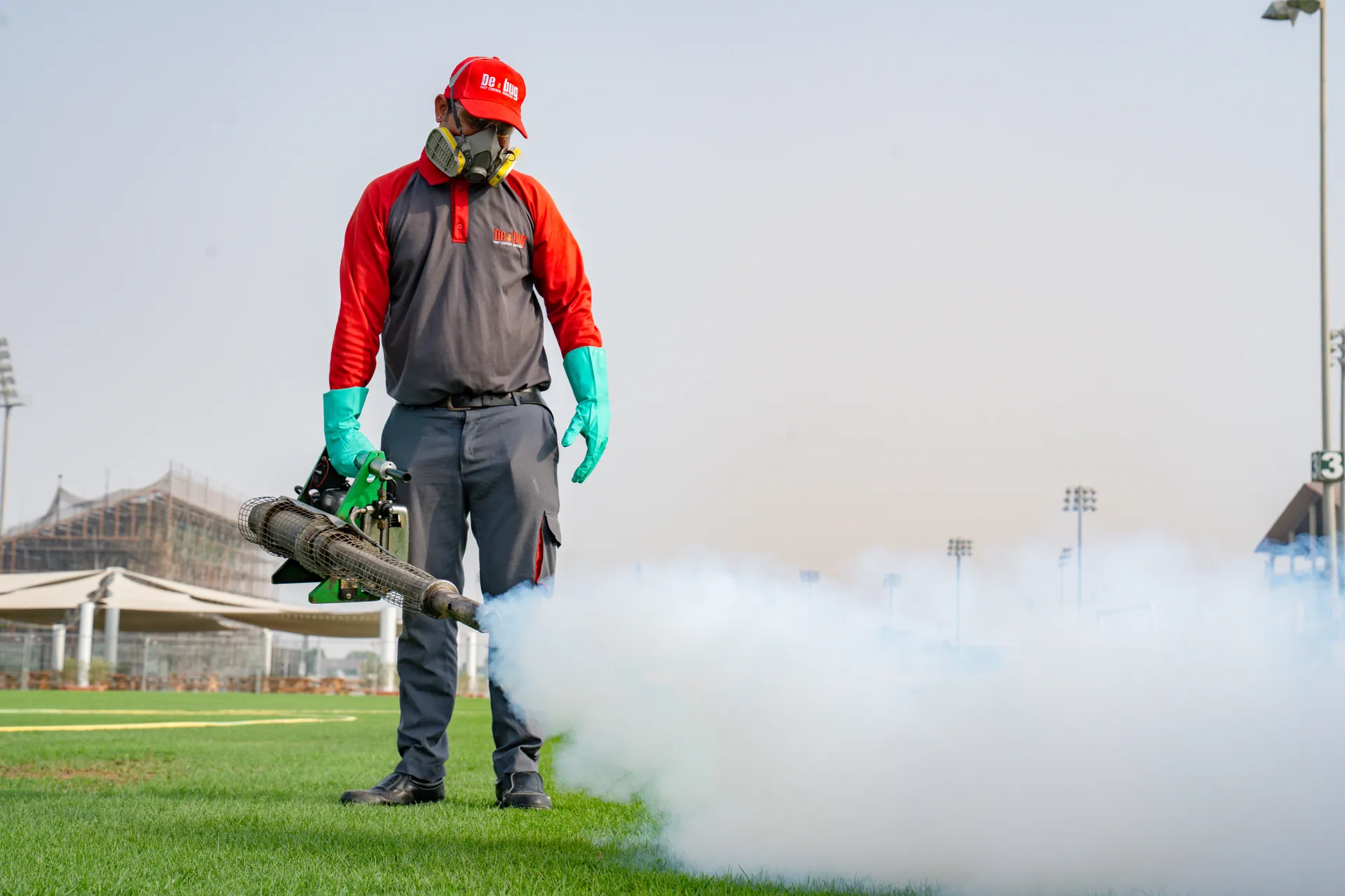
Heat Treatment Engineered for Dubai Properties
A heat treatment is only as good as the coldest spot in the room, because that is where the insects survive if it is missed. The whole protocol is built around making sure there is no such spot. For hotel rooms and serviced apartments in Downtown, Palm Jumeirah, and JBR, we set up portable industrial electric heaters and high-volume fans that bring the space to 56–60°C and hold it there for a sustained period. The holding time is the point, since the heat has to soak through mattresses and furniture, not just warm the air.
Wireless temperature sensors at the hardest-to-heat points, inside mattress folds, behind headboards, and within wardrobe cavities, confirm in real time that each one reached lethal temperature and stayed there, and the job is not signed off until the data shows every point did. For full details on our thermal treatment methodology, see our complete heat treatment process.
Dubai Municipality Requirements for Heat Treatment
Heat treatment pest control in Dubai is regulated by Dubai Municipality. The absence of chemicals does not put it outside that regulation, the licensing, the equipment, and the protocols all sit under DM oversight. Here is what the requirements come down to.
DM-Licensed Companies Only
Only companies holding a valid Dubai Municipality pest control license may carry out heat treatment in Dubai, and the technicians on the job must each carry their own DM certification card rather than working under the company license alone. Debug holds a valid DM license, with individually certified technicians on every treatment.
DM-Approved Equipment & Protocols
The equipment and the operating protocols for heat treatment in Dubai have to meet Dubai Municipality standards, which is where the gap between a proper thermal job and a set of hired heaters becomes a compliance issue rather than just a quality one. Debug uses calibrated industrial heating units with wireless temperature monitoring, so the uniform lethal temperature across the zone is achieved and documented rather than assumed.
Hospitality & Food Safety Compliance
Hotels, food warehouses, and catering facilities in Dubai have to keep documented pest management programs to satisfy Dubai Municipality food safety and public health inspections, and with heat treatment the temperature log is the proof the job actually worked. Debug provides fully audit-ready temperature logs and service reports with every session, so the evidence is on file before an inspector asks for it.
Commercial Trade Licence Renewal
Commercial properties in Dubai must keep an active pest control contract to renew their trade license, so letting it lapse is a licensing problem as well as a pest one. Debug's annual maintenance contracts meet the requirement with scheduled inspections and heat treatment applied as needed, keeping the property and its trade licence documentation current together.






What to Expect When You Book
Here is how the process runs, from the first call through to verified, documented results.
Inspection & Assessment
Book online or call, and we schedule a detailed inspection from our Jebel Ali branch. The technician identifies the target pest, bed bugs, stored-product insects, or both, maps how far it has spread, measures the treatment zone, and checks the electrical capacity the heating equipment will draw, a practical step that prevents problems on the day. Properties across Dubai, including Downtown, Dubai Marina, and Arabian Ranches, usually get a same-day or next-day inspection.
Preparation Guidance
We give you a preparation checklist matched to your property type. For hotel rooms and apartments, it mainly means removing heat-sensitive items, things like aerosols, candles, and certain electronics, and making sure windows and doors can be sealed. For warehouses, we coordinate with your operations team to prepare the stock areas. The preparation is genuinely light, and the thing people most expect to be a hassle is not: furniture and mattresses stay exactly where they are.
Thermal Treatment Session
Our technicians set up the portable industrial heaters and high-volume fans, seal the treatment zone, and raise it to 56–60°C. Wireless sensors placed through the space, inside mattress folds, behind headboards, and within racking confirm that every harbor reaches lethal temperature, not just the open air. The holding period usually runs six to eight hours depending on the room size and the target pest, because the heat needs time to penetrate the materials the insects shelter in.
Verification & Warranty
After cool-down, we inspect the treated area and review the temperature logs to confirm lethal exposure was reached at every monitoring point, not just most of them. You receive a detailed report with time-stamped temperature data for your own records and any compliance needs. Our service warranty covers recurrence, and for ongoing protection you can ask about our annual maintenance contracts in Dubai.
Frequently Asked Questions
Everything you need to know about heat treatment pest control in Dubai.
Yes, and for difficult cases it is the most effective option available. Its advantage is that it kills the eggs, which is where chemical treatments fail. By holding the whole space at 56–60 °C long enough for the heat to reach every harborage, a single session clears adults, nymphs, and eggs at once, rather than leaving eggs to hatch and restart the infestation.
We give you a checklist beforehand, but it is light. The main task is removing a short list of heat-sensitive items, aerosols, candles, certain electronics, medications, and making sure windows and doors can be sealed. Furniture, mattresses, and most belongings stay in place and get treated where they are, so there is no major packing or moving to do.
Typically six to eight hours, depending on the size of the space and the target pest. Most of that time is the holding period, where the lethal temperature is maintained so the heat penetrates the materials the insects hide in. The setup and cool-down sit either side of it.
Yes. It is widely used for hotels, serviced apartments, food warehouses, and catering facilities across Dubai. For food logistics sites in particular it has a real edge, since it reaches into palletized stock and racking that fumigant gases cannot, and it produces the documented temperature record that Dubai Municipality food safety compliance calls for.
Yes. Our heat treatment carries a service warranty covering recurrence, and you receive a detailed report with time-stamped temperature data confirming lethal exposure was reached at every monitoring point. For properties wanting continued protection, an annual maintenance contract adds scheduled inspections and treatment as needed.
What Dubai Clients Say
Real results from real customers across Dubai — sourced from verified Google Reviews.
Book Heat Treatment in Dubai Today
Stop the cycle of failed chemical treatments. Debug delivers single-session heat treatment that eliminates 100% of bed bugs and stored-product insects — eggs included. Chemical-free, Dubai Municipality licensed, and backed by our service warranty.
Licensed by Dubai Municipality. Rated 4.8★ on Google.