

Smart Mosquito Trap Setup in Abu Dhabi
From villa compounds in Khalifa City and Al Reef to waterfront homes on Al Reem Island and Saadiyat Island, Debug designs and installs trap networks built around each property's layout. We work from a Mussafah facility with ADAFSA-licensed technicians providing smart mosquito trap services across the UAE. Call +971 2 307 4605 or book your free site survey online.
Why Smart Mosquito Traps Are Essential in Abu Dhabi
The telling thing about mosquitoes in Abu Dhabi is that they persist even on properties that fog regularly. The mangrove habitats, the landscaped compounds, and the waterfront developments breed them faster than periodic treatment can clear them, so the relief never quite holds. Smart traps address what fogging cannot: the gap between treatments. By capturing mosquitoes around the clock, they suppress the population continuously rather than in bursts, which is why they fit so well into a modern integrated mosquito management programme. They are not a replacement for everything else, they are the part that keeps working when the fogging has worn off. Properties going this route often pair the traps with green pest control to keep the whole approach chemical-free across the grounds.
Mangroves & Coastal Wetlands
Abu Dhabi's coastal mangrove reserves, the Eastern Mangroves, Jubail Island, and Saadiyat's northern shoreline, are beautiful and ecologically vital, and they are also enormous mosquito nurseries. The brackish tidal pools sustain Culex and Anopheles breeding all year, and the mosquitoes that emerge do not stay put. They disperse up to 3 km inland, which is enough to carry them well into the residential developments on Al Reem Island, Saadiyat Island, and Al Raha. You cannot, and should not, fog a protected mangrove. What you can do is intercept the mosquitoes once they arrive, which is exactly where perimeter trap placement earns its keep, catching them before they reach the outdoor living areas. CO₂ traps are particularly effective against the mangrove-breeding Culex species, and because they capture rather than spray, they reduce the population without touching the mangrove ecology.
- Mangrove tidal pools sustain year-round Culex and Anopheles breeding
- Mosquitoes disperse up to 3 km from coastal breeding sites into communities
- Al Reem Island and Saadiyat properties face the highest mangrove-origin pressure
- Perimeter trap placement intercepts mosquitoes before they reach living spaces
- CO₂ traps are particularly effective against mangrove-breeding Culex species
- Continuous trapping reduces populations without disrupting mangrove ecology
Irrigated Gardens & Villa Communities
In the villa compounds of Khalifa City, Al Reef, Al Ghadeer, and MBZ City, the mosquito problem is often homegrown rather than blown in from the coast. The extensive irrigated gardens, ornamental ponds, and landscaping all create standing water, and Aedes mosquitoes need surprisingly little of it, a blocked drip line, an irrigation catch basin, even a saucer under a plant pot is enough to breed in, often within metres of where the family sits outside. Smart traps placed in the garden zones catch the females as they hunt for a blood meal, which is the moment that matters, because a female removed before she lays is a whole egg batch that never happens. Over successive capture cycles the breeding population keeps dropping, and the trap catch data shows you which zones are most active so garden maintenance can target them.
- Irrigation catch basins and blocked drip lines create persistent breeding sites
- Khalifa City and Al Reef compounds report the highest residential mosquito activity
- Aedes mosquitoes breed in containers as small as saucers and pot trays
- Garden-placed traps capture females before they lay the next egg batch
- Population reduction compounds over weeks as breeding females are removed
- Trap data identifies peak activity zones for targeted garden maintenance
Waterfront Communities
The waterfront developments on Yas Island, Al Reem Island, and Saadiyat Island, with their promenades, marina berths, pools, and decorative water features, draw mosquitoes in from the surrounding coastal habitats. They are also exactly the settings where fogging makes least sense: spraying chemicals near open water, marinas, and swimming pools raises real environmental and health questions, and residents do not want it around their outdoor dining in any case. Smart traps suit this living perfectly. They run silently and continuously, leave no chemical residue, and have no effect on marine wildlife or pool water chemistry. A perimeter network around a marina development, or pool-adjacent traps near outdoor dining, cuts the evening mosquito activity without intruding on the landscaping or the lifestyle.
- Waterfront developments attract mosquitoes from adjacent coastal breeding zones
- Chemical fogging near pools and marinas raises environmental and health concerns
- Smart traps operate silently and continuously without chemical residue
- Yas Island and Al Reem marina developments benefit from perimeter trap networks
- Pool-adjacent traps reduce evening mosquito activity around outdoor dining areas
- Trap networks complement existing landscaping without visual intrusion
Limitations of Conventional Fogging
Fogging has a real role, but it is worth being clear about its limits. The knockdown it delivers is fast but short, typically 48 to 72 hours, after which the population recovers if breeding females are still active nearby. It also cannot be used in a lot of Abu Dhabi settings: near food preparation areas, in residential compounds during daytime hours, or next to sensitive ecological zones like the mangroves. Those restrictions leave gaps, and the gaps are where mosquitoes rebuild. Smart traps fill them by capturing around the clock, with no airborne chemical at all, so the suppression accumulates instead of resetting every few days. The catch data is a bonus most chemical methods cannot offer: measurable proof of how much the population has actually come down.
- Fogging provides only 48–72 hours of adult mosquito knockdown
- Fogging is restricted near food preparation, occupied spaces, and ecological zones
- Smart traps operate 24/7 with no airborne chemical dispersal
- Continuous capture compounds over time for sustained population reduction
- Trap catch data provides measurable evidence of mosquito reduction
- Ideal for properties where chemical fogging is impractical or prohibited
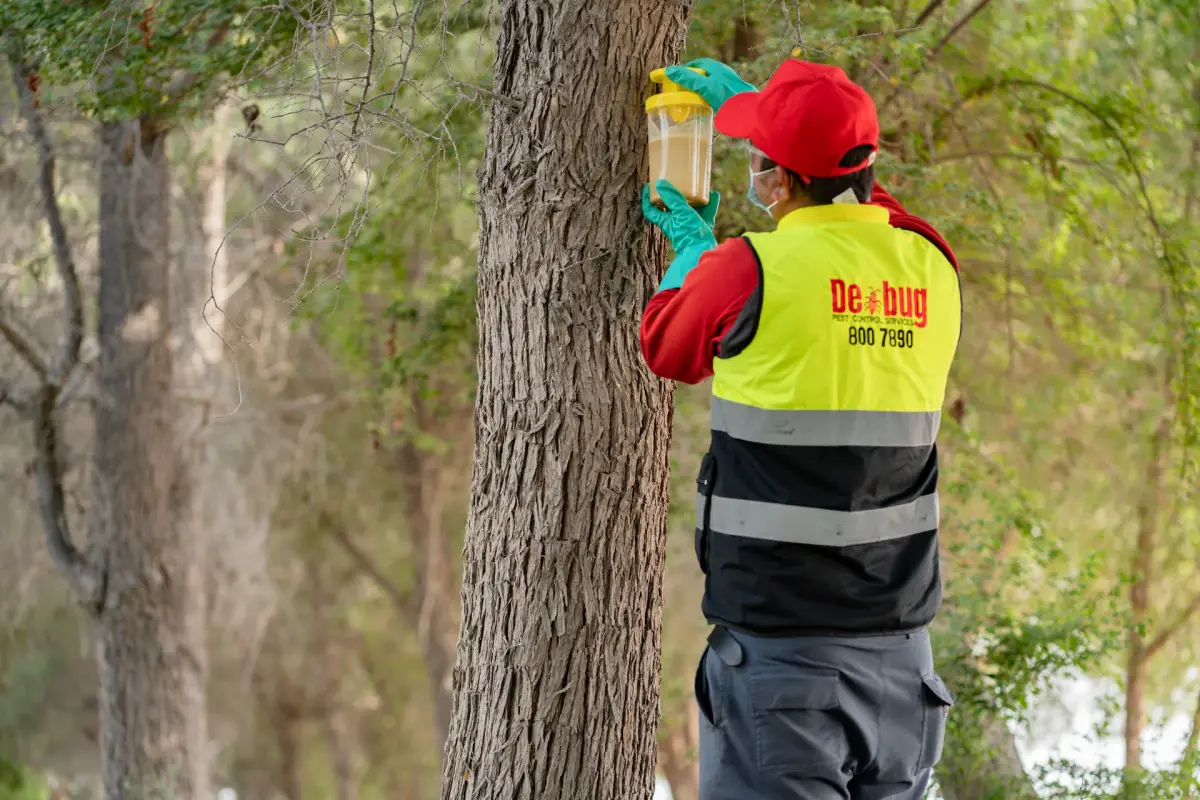
Smart Trap Networks Designed for Abu Dhabi Properties
A trap in the wrong place catches almost nothing, so every installation starts with a detailed site survey to map the mosquito entry routes, the breeding hot spots, and the outdoor living zones the system is meant to protect. In villa compounds across Khalifa City, Mussafah, Al Reef, and Al Ghadeer, we trace the irrigation-related breeding sites and position CO₂ attraction traps along the garden perimeters and near the seating areas, so the females are intercepted before they reach the family spaces. For the waterfront properties on Yas Island, Saadiyat Island, and Al Reem Island, we design perimeter networks instead. Every placement is calculated, not guessed, against the prevailing wind direction, the vegetation density, and the proximity to known breeding sources, because those three factors decide whether a trap sits in the mosquitoes' path or off to one side of it. For full details, see our complete smart mosquito trap service.
ADAFSA Requirements for Mosquito Management in Abu Dhabi
Mosquito management in Abu Dhabi is regulated by the Abu Dhabi Agriculture and Food Safety Authority (ADAFSA), and smart trap installation falls under the same oversight as any other pest service: it has to be done by licensed operators using approved equipment. Here is what that involves.
ADAFSA-Licensed Operators
All pest management in Abu Dhabi, smart trap installation and maintenance included, must be carried out by ADAFSA-licensed companies whose technicians hold their own individual certification rather than working under the company licence alone. Debug maintains full ADAFSA licensing for its Abu Dhabi operations, with certified technicians on every survey and service visit.
Integrated Pest Management Compliance
ADAFSA encourages integrated pest management approaches that keep chemical use to a minimum, and smart mosquito traps sit squarely within that, providing continuous physical capture with no chemical dispersal at all. This makes them an easy fit for the IPM documentation that commercial and residential properties are expected to maintain, and Debug's trap programmes are set up to satisfy those requirements rather than just meet them on paper.
Community & Facility Management Documentation
illa compounds and commercial facilities in Abu Dhabi have to keep documented pest management programmes, both for community management and for ADAFSA compliance, and traps have an advantage here that sprays do not: they generate hard data. Debug provides fully audit-ready service reports with every scheduled visit, including the trap catch data, maintenance logs, and population trend analysis, so the documentation shows results rather than just activity.
Commercial Trade Licence Renewal
Commercial properties in Abu Dhabi must keep an active pest control contract to satisfy trade licence renewal conditions. Debug's annual maintenance contracts incorporate smart trap monitoring alongside conventional treatments to meet that requirement, so the same arrangement that keeps the mosquitoes down also keeps the trade licence documentation current.




What to Expect When You Book
Here is how the process runs, from the first site survey through to ongoing maintenance.
Free Site Survey
Book online or call, and we arrange a detailed site survey from our Mussafah branch. A technician visits to map your outdoor living areas, trace the mosquito entry routes and breeding hot spots, and check the power supply options for trap placement, since that determines where traps can realistically go. Properties across the Abu Dhabi mainland, including Khalifa City, Al Reef, and MBZ City, are usually surveyed within 48 hours.
Custom Trap Network Design
The survey findings drive the design. We select the trap type for your property, CO₂ attraction, UV, or a combination, map the placements against wind direction and vegetation, plan the power supply as mains or solar depending on the site, and give you estimated catch rates. You receive a clear proposal with a layout diagram before any work starts, so you can see exactly where everything goes and why.
Professional Installation
Our technicians install each trap at the mapped locations, connect the power supplies, calibrate the CO₂ flow rates, and activate the system. A typical villa installation takes two to four hours. Before we leave, we walk you through how the system works and show you how to check the capture containers between service visits, so you are not left guessing about what is happening.
Scheduled Maintenance & Monitoring
A smart trap only keeps working if it is serviced, so every trap is on a regular maintenance cycle, typically fortnightly through the peak mosquito season and monthly in the cooler months. Each visit covers CO₂ cartridge replacement, capture container cleaning, catch data logging, and placement adjustment as the seasonal patterns shift. We share the catch data reports with you so you can track the reduction in real numbers rather than taking it on trust. For comprehensive year-round protection, ask about our annual maintenance contracts in Abu Dhabi.
Frequently Asked Questions
Everything you need to know about smart mosquito traps in Abu Dhabi.
They exploit how mosquitoes hunt. The traps emit attractants, principally CO₂, which mimics the breath of a human or animal, drawing in the female mosquitoes that are searching for a blood meal. Once lured in, they are captured rather than repelled or sprayed. Because it is the egg-laying females being removed, each capture cycle reduces the next generation, so the population falls progressively the longer the system runs.
Yes. That is one of their main advantages over fogging. The traps capture mosquitoes physically and disperse no chemicals into the air or onto surfaces, so there is no residue and no re-entry concern. They are safe to run continuously around children, pets, pools, and outdoor dining areas, which is exactly where they tend to be placed.
You will usually notice fewer mosquitoes within the first week or two as the active adults are captured, but the bigger effect builds over the following weeks as breeding females are removed before they can lay. Smart trapping is a compounding approach rather than an instant one, which is also why it produces more lasting results than a one-off fog.
For many properties, yes, particularly waterfront homes, compounds near mangroves, and any site where fogging is restricted. On others, the two work best together: fogging for a fast knockdown when activity spikes, and traps for the continuous suppression that keeps the population from rebuilding between fogs
Regular servicing, which we handle on a scheduled cycle, typically fortnightly in peak season and monthly when it is cooler. Each visit covers cleaning the capture containers, replacing CO₂ cartridges where used, logging the catch data, and adjusting placement for the season. Between visits, there is little for you to do beyond an occasional glance at the capture containers, which we show you how to check at installation.
What Abu Dhabi Property Owners Say
Real results from real customers across Abu Dhabi — sourced from verified Google Reviews.
Book Smart Mosquito Trap Installation in Abu Dhabi Today
Stop chasing mosquitoes with temporary fixes. Debug installs smart trap networks that deliver continuous, chemical-free mosquito reduction across your Abu Dhabi property — from Khalifa City compounds to Saadiyat Island waterfront villas.
Licensed by ADAFSA. Rated 4.8★ on Google.