
Smart Mosquito Trap Installs in Fujairah
The East Coast microclimate, with Indian Ocean humidity, mountain wadis holding water long after rain, and agricultural irrigation running year-round, gives mosquitoes the moisture and warmth they need for far more of the year than the western desert emirates ever see. That extended season is the central reason fogging struggles here: a monthly cycle leaves long gaps in a season that never properly closes. Smart mosquito traps work the other way, attracting and capturing the female mosquitoes, the ones that bite and breed, around the clock and chemical-free. From residential villas in Fujairah City to coastal developments in Al Faseel and agricultural properties near Qidfa, Debug designs and installs trap networks tailored to each property's layout. We work from a Fujairah office in Al Hail Village, bringing the same BPCA- and NPMA-accredited standard relied on across the UAE. Call +971 2 307 4605 or book your free site survey online.
Why Mosquito Activity Is More Severe in Fujairah
Fujairah's mosquito pressure does not come from one source, it comes from three working together, and that is what makes it distinct from Dubai and Abu Dhabi. The wadi systems trap standing water for weeks after rain. The Indian Ocean humidity keeps adult mosquitoes alive and feeding for longer. And the agricultural irrigation across the foothills breeds them continuously. Each one alone would be manageable. Together they sustain mosquito activity across most of the year, which is exactly why a periodic, reactive approach falls short here and continuous control becomes the sensible option. Properties going this route often pair the traps with green pest control to keep the whole approach across the grounds chemical-free.
Wadi Systems Create Seasonal Breeding Zones
Fujairah's wadi systems, Wadi Ham, Wadi Al-Wurayah, and the smaller seasonal watercourses, hold pools of standing water for weeks after a rainfall event, and those pools are prolific mosquito breeding sites while they last. The catch is their unpredictability: wadi flow activates breeding grounds on its own schedule, so the surge often arrives without warning. Properties in Fujairah City, Mirbah, and Qidfa that border wadi areas feel it most, with Aedes and Culex both breeding in the fresh and brackish water the wadis leave behind. You cannot drain a wadi, but you can intercept what emerges from it. Smart traps along the property perimeter catch the arriving females before they reach the garden and locate breeding sites closer to the house, and CO₂ traps are well suited to catching them at that point.
- Wadi pools retain standing water for weeks after rainfall events
- Aedes and Culex species breed in both fresh and brackish wadi water
- Fujairah City and Mirbah properties bordering wadis face the highest pressure
- Seasonal wadi flow creates unpredictable breeding site activation
- Perimeter trap placement intercepts mosquitoes from wadi breeding zones
- CO₂ traps capture arriving females before they locate garden breeding sites
Coastal Humidity Extends Mosquito Season
Humidity does more for mosquitoes than just feel uncomfortable, it keeps them alive longer. Fujairah's Indian Ocean coastline pushes ambient humidity well above the western emirates, frequently past 80% through the summer, and that elevated moisture extends adult mosquito lifespan and increases how often they feed. The practical result is a mosquito season that runs well past the April-to-October peak that Abu Dhabi and Dubai experience, with the Al Faseel and Dibba Al-Fujairah coastal zones reporting activity for longer than most. A longer season needs a longer answer, which is where year-round trapping comes in, and UV traps are particularly effective for the night-active coastal species that the extended season brings out.
- Coastal humidity frequently exceeds 80% during the summer months
- Higher humidity extends adult mosquito lifespan and feeding activity
- Fujairah's mosquito season is longer than in the western desert emirates
- Al Faseel and Dibba Al-Fujairah coastal zones report extended activity
- Year-round trapping addresses the prolonged active season
- UV traps are particularly effective for night-active coastal species
Agricultural Irrigation & Farm Properties
Fujairah's agricultural zones around Qidfa, Mirbah, and the mountain foothills run on flood irrigation and canal systems, and those leave standing water in exactly the places mosquitoes want it: field margins, irrigation channels, and collection basins. The water that grows the crops also breeds mosquitoes, year-round, and they do not stay on the farm. They disperse from the farmland into the neighbouring residential and commercial properties, so a home next to agricultural land inherits the farm's mosquito pressure. The effective approach here is the barrier: smart traps on the farm boundaries and around residential buildings adjacent to agricultural land, placed to intercept the farm-origin mosquitoes at the transition zone before they reach the homes. For the remote sites where mains power is impractical, solar-powered trap options keep the barrier running.
- Flood irrigation leaves standing water in channels and field margins
- Qidfa and Mirbah agricultural zones generate surrounding mosquito pressure
- Farm irrigation basins and collection tanks breed mosquitoes year-round
- Mosquitoes disperse from farmland into adjacent residential properties
- Boundary trap placement intercepts farm-origin mosquitoes before they reach homes
- Solar-powered trap options available for remote agricultural installations
Why Fogging Alone Is Not Enough
Fogging has a role, but Fujairah's terrain and season expose its limits more than most places. The knockdown is fast and short, typically 48 to 72 hours, and the fog cannot reach the mosquitoes harboured in wadi vegetation, agricultural irrigation systems, or mountain-adjacent terrain, which is where a great deal of the breeding actually happens. Then the extended season compounds the problem: a monthly fogging cycle that might suffice in a short western-emirate season leaves long unprotected gaps in Fujairah's drawn-out one. Smart traps close those gaps by capturing round the clock, continuously, regardless of terrain or weather, so the suppression accumulates instead of resetting every few days. For the rural and semi-rural properties where fogging coverage is patchy to begin with, that continuous operation is the real advantage.
- Fogging provides only 48–72 hours of adult mosquito knockdown
- Wadi vegetation and agricultural areas limit fogging penetration
- Fujairah's extended season means monthly fogging leaves long unprotected gaps
- Smart traps operate 24/7 continuously regardless of terrain or weather
- Continuous capture compounds over time for sustained population reduction
- Ideal for rural and semi-rural properties where fogging coverage is limited
Smart Trap Systems Designed for East Coast Conditions
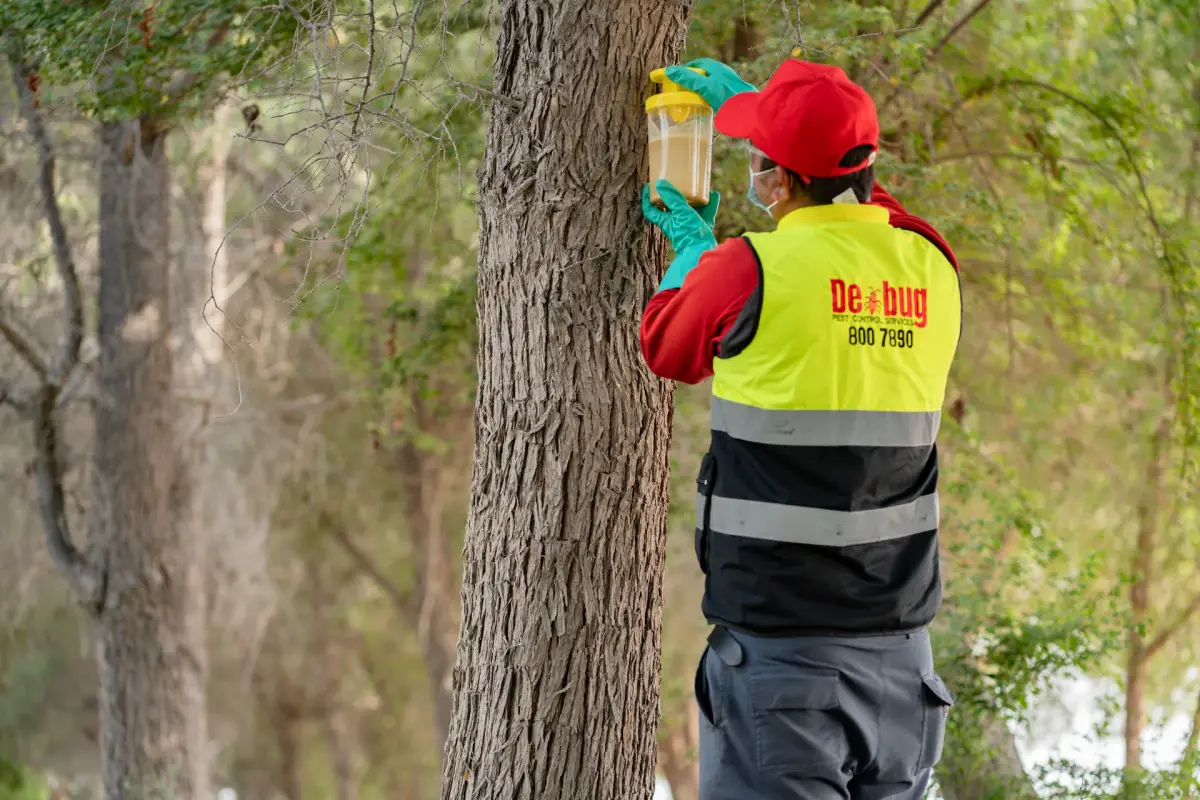
Fujairah's terrain is the reason a standard installation plan does not transfer here. Unlike the flat urban landscapes of Abu Dhabi and Dubai, the East Coast brings mountain-backed terrain, wadi systems, agricultural irrigation zones, and elevated coastal humidity, and each shapes how mosquitoes move and breed differently. So every installation starts with a detailed site survey that assesses the wadi proximity, the humidity conditions, the vegetation density, the prevailing wind, the irrigation sources, the power availability, and the actual mosquito activity zones. From that, we design a network suited to the specific property, whether it is a residential villa, an apartment community, a hotel or resort, an agricultural property, a farm or nursery, an industrial facility, or a school. The placement strategy follows the terrain, because on the East Coast the terrain is the deciding factor. For full details, see our complete smart mosquito trap service.
Fujairah Municipality Requirements for Mosquito Management
Mosquito management in Fujairah is regulated by Fujairah Municipality, and smart trap installation falls under the same oversight as any other pest service. Knowing the requirements helps you check that whoever services your property is genuinely compliant. Here is what they involve.
Licensed Pest Control Operators
Fujairah Municipality requires every pest control company to hold a valid municipal licence, and the technicians on the job to carry their own individual certification rather than working under the company licence alone. Debug operates with full Fujairah Municipality approval, with certified technicians, trained in integrated pest management, on every survey and service visit.
Approved Methods & Equipment
All pest management methods and equipment used in Fujairah have to be approved by the relevant UAE authorities. Smart mosquito traps fit neatly within the integrated pest management principles the municipality endorses, since they capture physically rather than dispersing chemicals, and Debug uses only approved equipment in every installation.
Hospitality & Food Safety Compliance
Hotels, restaurants, and food-handling businesses in Fujairah have to keep documented pest control programmes to satisfy health inspection requirements, and traps have an advantage here that sprays do not: they generate hard data. Debug provides fully audit-ready documentation with every service visit, including the trap catch data, maintenance logs, and population trend analysis, so the records show results rather than just activity.
Commercial Property Requirements
Commercial premises in Fujairah are required to maintain an active pest control contract for trade licence renewal. Debug's annual maintenance contracts incorporate smart trap monitoring alongside conventional treatments to satisfy that requirement, so the same arrangement that keeps the mosquitoes down also keeps the trade licence documentation current.




What to Expect When You Book
Here is how the process runs, from the first site survey through to ongoing maintenance.
Free Site Survey
Book online or call, and we arrange a detailed site survey from our Fujairah office in Al Hail Village. A technician visits to map your outdoor areas, trace the mosquito entry routes and breeding hot spots, including wadi proximity and irrigation sources specific to Fujairah, and check the power supply options for trap placement. Being locally based on the East Coast, we can respond faster than providers driving over from Dubai or Sharjah.
Custom System Design
The survey findings drive the design. We select the trap type for your conditions, CO₂ attraction, UV, or a combination, map the placements against wadi proximity, coastal wind patterns, and vegetation, and plan the power supply, with solar options for the remote and agricultural locations where mains power is limited. You receive a clear proposal with a layout diagram before any work begins, so you can see exactly where everything goes and why.
Professional Installation
Our technicians install each trap at the mapped locations, connect the power supplies as mains or solar, calibrate the CO₂ flow rates, and activate the system. A typical residential installation takes two to four hours. For agricultural and rural properties, we allow extra time for the solar panel mounting and the extended perimeter runs those sites need, and we walk you through how the system works before we leave.
Scheduled Maintenance & Monitoring
A smart trap only keeps working if it is serviced, so every trap runs on a regular maintenance cycle, typically fortnightly through the peak season and monthly in the cooler months. Fujairah's extended season changes this slightly: we hold the higher service frequency for longer here than in the western emirates, because the active season runs longer. Each visit covers CO₂ cartridge replacement, capture container cleaning, catch data logging, and seasonal placement adjustment. For comprehensive year-round protection, ask about our annual maintenance contracts in Fujairah.
Frequently Asked Questions
Everything you need to know about smart mosquito traps in Fujairah.
They use the cues mosquitoes hunt by, attracting the female mosquitoes with CO₂, heat, and on some models UV light and airflow, to mimic a human or animal. Once drawn in, the mosquitoes are captured rather than repelled. Because it is the egg-laying females being removed, each capture cycle reduces the next generation, so the population falls progressively, gradually but measurably, the longer the system runs.
Yes, and wadi-adjacent properties are one of the situations they suit best in Fujairah. After rainfall, wadis breed mosquitoes in surges, and traps positioned around the property boundary create a barrier that intercepts them as they migrate out of the wadi, before they reach the gardens and outdoor seating. Proper placement against the wadi and the prevailing wind is what makes the difference, which is why the site survey matters.
Yes. Solar-powered installations are available for farms, agricultural facilities, and remote sites where mains electricity is limited or absent, which is common across Fujairah's foothill agricultural zones. The solar option lets us extend the trap barrier out to the field boundaries that need it without depending on a mains connection.
Yes. They capture mosquitoes physically and use no chemical spray or airborne pesticide, so there is no residue and no re-entry concern. That makes them suitable to run continuously around homes, gardens, farms, and outdoor family spaces, which is exactly where they tend to be placed.
Yes. Our office is in Al Hail Village, which keeps our local licensing current and lets us provide faster response and dedicated local support across the East Coast than providers travelling in from Dubai or Sharjah, for the survey, the installation, and the ongoing maintenance alike.
What Fujairah Clients Say
Real results from real customers — sourced from verified Google Reviews.
Book Smart Mosquito Trap Installation in Fujairah Today
Debug brings the same professional standard to Fujairah that we deliver across the UAE. Local office, licensed technicians, and smart mosquito trap networks adapted to the East Coast's wadi terrain and coastal humidity.
Fujairah Municipality compliant. BPCA & NPMA accredited. ISO certified.