

Smart Mosquito Traps in Sharjah
Khalid Lagoon and the lake waterways run right through the urban core, giving Culex mosquitoes a permanent breeding ground in the middle of the city, while the older drainage infrastructure across the established neighbourhoods holds stagnant water in places fogging can never reach. Add some of the densest building layouts in the UAE, which block airflow and shelter mosquitoes, and you have conditions that periodic fogging simply cannot keep on top of. Smart mosquito traps work differently. They attract and capture the female mosquitoes, the ones that bite and breed, before they can do either, running continuously and chemical-free. From apartments in Al Nahda and Al Majaz to villa compounds in Muwaileh and Al Taawun, Debug designs and installs trap networks tailored to each property's layout. We work from a Sharjah office at 203, K3 Building, Al Darari Commercial, with Sharjah Municipality-licensed technicians providing smart mosquito trap services across the UAE. Call +971 6 546 2378 or book your free site survey online.
Why Smart Mosquito Traps Are Essential in Sharjah
Fogging has a particular weakness in Sharjah, and it is physical. The dense building layouts and enclosed courtyards block the fog from dispersing, and the mosquitoes breed and shelter in drainage structures the fog cannot enter, so even a thorough treatment leaves the actual breeding sites untouched. Combine that with lagoon water bodies producing mosquitoes year-round, and the relief from any single fog is both partial and short-lived. Smart traps get around the problem by being placed exactly where the mosquitoes are, in the courtyards, perimeters, and communal zones, capturing them around the clock rather than in a passing cloud. Properties going this route often pair the traps with green pest control to keep the whole approach across the grounds chemical-free.
Lagoon Areas & Waterfront Communities
Sharjah's lagoon waterways and Khalid Lake form a network of standing and slow-moving water running right through the city, and that water sustains massive Culex mosquito populations all year. Unlike a coastal mangrove out on the edge of town, this breeding ground sits in the middle of dense residential areas, so the properties in Al Majaz, Al Khan, and along the Corniche strip take a persistent influx, heaviest in the evenings when Culex are most active. You cannot drain or fog an urban lake, but you can intercept what comes off it. Smart traps positioned along the lagoon-facing perimeters catch the mosquitoes arriving from the waterside before they reach the living and working spaces, and CO₂ traps are especially effective against the Culex species that breed in this kind of standing water, all without disturbing the lagoon ecology.
- Khalid Lake and lagoon waterways sustain year-round Culex breeding
- Al Majaz and Al Khan properties face the highest lagoon-origin mosquito pressure
- Corniche-adjacent properties receive a persistent evening mosquito influx
- Perimeter trap placement intercepts mosquitoes from waterside breeding sites
- CO₂ traps are particularly effective against Culex species from standing water
- Continuous trapping reduces populations without disrupting lagoon ecology
Dense Residential Communities
In Sharjah's established neighbourhoods, the mosquitoes breed in the infrastructure itself. Al Qasimia, Al Nahda, and parts of the Industrial Area have older drainage that retains stagnant water in manholes, catch basins, and poorly graded service lanes, creating prolific Aedes and Culex breeding sites woven right into the urban fabric. The dense building layouts then make the problem harder to treat from both directions: they limit airflow, so fogging cannot penetrate, and they create sheltered microclimates where mosquitoes thrive between treatments. Small containers left in communal building areas add further Aedes breeding spots. This is precisely the setting smart traps are built for, targeted placement that reaches the courtyards, service lanes, and communal zones the fog never gets into.
- Older manholes and catch basins retain stagnant water ideal for breeding
- Al Qasimia and Al Nahda report the highest urban mosquito complaints in Sharjah
- Dense building layouts reduce fogging penetration and create sheltered microhabitats
- Service lanes and parking areas with poor drainage accumulate breeding water
- Aedes mosquitoes breed in small containers left in communal building areas
- Targeted trap placement addresses mosquitoes that fogging cannot reach
Muwaileh & Expanding Residential Communities
Sharjah's newer developments around Muwaileh and University City bring a different version of the problem. The irrigated landscaping, ornamental water features, and communal garden areas that make these communities pleasant also introduce fresh Aedes breeding opportunities, and the irrigation systems become more of a factor as they bed in. On top of that, the construction activity that comes with expanding communities creates temporary standing-water pools in excavations and staging areas. The advantage here is timing: installing traps early, as a community matures and its landscaping irrigation establishes, stops the mosquito population getting a foothold in the first place rather than fighting it once entrenched.
- Irrigated landscaping in new developments creates Aedes breeding sites
- University City communal gardens sustain mosquito populations near residences
- Construction staging areas accumulate temporary standing water
- Muwaileh villa communities benefit from garden-perimeter trap placement
- Water features and ornamental ponds require targeted trap coverage
- Early trap installation in new communities prevents population establishment
Why Fogging Alone Is Not Enough
Fogging has its place, but in Sharjah its limits are stark. The knockdown is fast and short, typically 48 to 72 hours, after which the population rebuilds if breeding sites are still active. And the city's physical layout works against it: fogging cannot penetrate enclosed courtyards, dense building clusters, or the drainage infrastructure where Sharjah's mosquitoes actually breed and shelter, so the fog clears the open air while the breeding zones carry on untouched. Smart traps fill that gap by capturing round the clock in the precise spots where mosquitoes are most active, with no airborne chemical at all, so the suppression accumulates instead of resetting every few days. The catch data is something fogging cannot offer: measurable proof of the reduction, which matters for building management and municipality inspections alike.
- Fogging provides only 48–72 hours of adult mosquito knockdown
- Dense urban layouts in Sharjah limit fogging penetration and dispersal
- Smart traps operate 24/7 in targeted locations fogging cannot reach
- Continuous capture compounds over time for sustained population reduction
- Trap catch data provides measurable evidence of mosquito reduction
- Ideal for residential blocks where fogging access is restricted
Smart Trap Networks Designed for Sharjah Properties
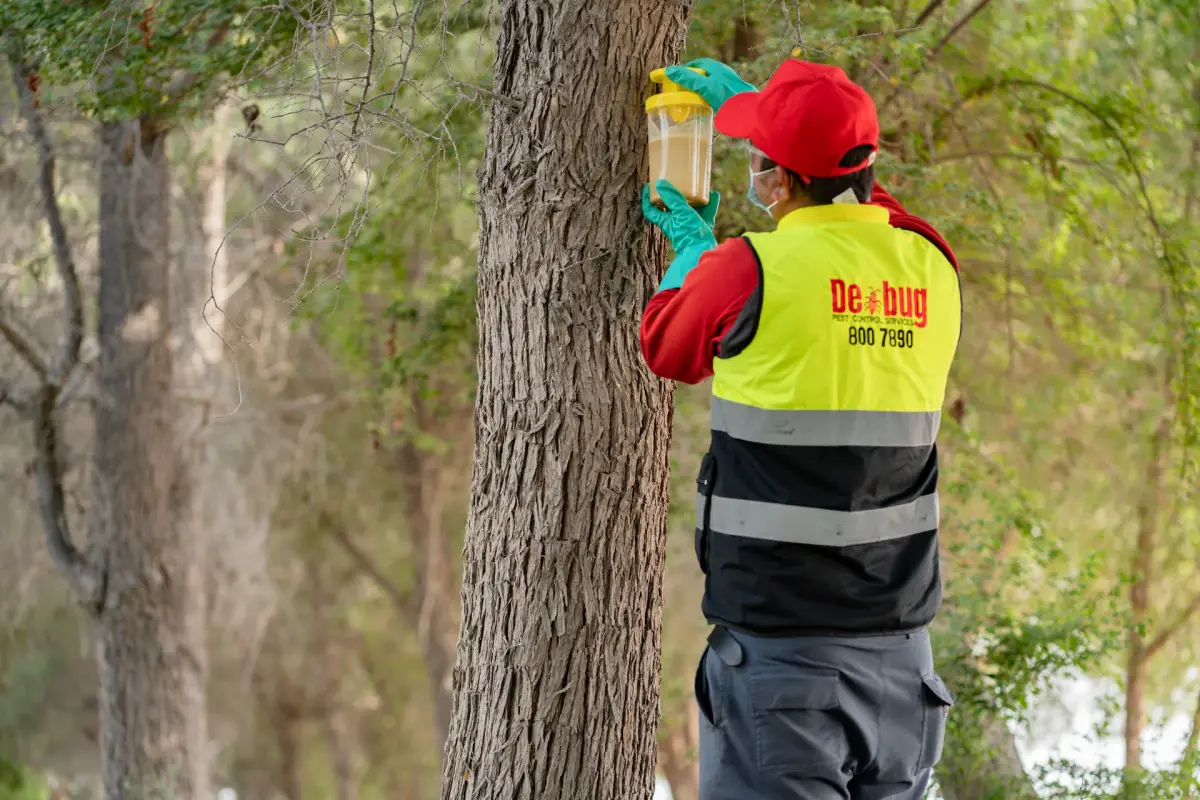
A trap in the wrong place catches almost nothing, so every Sharjah installation starts with a detailed site survey to map the mosquito entry routes, the breeding hot spots, and the outdoor living zones the system is meant to protect. For lagoon-adjacent properties across Al Majaz, Al Khan, and the Corniche, we position CO₂ attraction traps along the waterfront-facing perimeters to intercept the Culex mosquitoes arriving from Khalid Lake and the lagoon waterways.
For dense residential developments and villa compounds, the focus shifts to the courtyards, communal spaces, gardens, and the areas with poor drainage where the mosquitoes actually breed. Each placement is calculated, not guessed, against the prevailing wind direction, the building orientation, and the proximity to known water-body breeding sources, because those decide whether a trap sits in the mosquitoes' path or off to one side of it. For full details, see our complete smart mosquito trap service.
Sharjah Municipality Requirements for Mosquito Management
Mosquito management in Sharjah is regulated by Sharjah Municipality, and smart trap installation falls under the same oversight as any other pest service: it has to be done by licensed operators using approved equipment and methods. Here is what that involves.
Municipality-Licensed Operators
All pest management in Sharjah, smart trap installation and maintenance included, must be carried out by Sharjah Municipality-licensed companies whose technicians hold their own individual certification rather than working under the company licence alone. Debug maintains full Sharjah Municipality licensing for its operations in the emirate, with certified technicians on every survey and service visit.
Integrated Pest Management Compliance
Sharjah Municipality supports integrated pest management approaches that keep chemical use to a minimum, and smart mosquito traps sit squarely within that, providing continuous physical capture with no chemical dispersal at all. That makes them an easy fit for the IPM documentation commercial and residential properties are expected to maintain, and Debug's trap programmes are set up to satisfy those requirements rather than just meet them on paper.
Building Management Documentation
Residential towers and commercial buildings in Sharjah have to keep documented pest management programmes, and traps have an advantage here that sprays do not: they generate hard data. Debug provides fully audit-ready service reports with every scheduled visit, including the trap catch data, maintenance logs, and population trend analysis, which satisfies both building management and municipality inspection requirements while showing results rather than just activity.
Commercial Trade Licence Renewal
Commercial properties in Sharjah must keep an active pest control contract for trade licence renewal. Debug's annual maintenance contracts incorporate smart trap monitoring alongside conventional treatments to meet that requirement, so the same arrangement that keeps the mosquitoes down also keeps the trade licence documentation current.





What to Expect When You Book
Here is how the process runs, from the first site survey through to ongoing maintenance.
Free Site Survey
Book online or call, and we arrange a detailed site survey from our Sharjah office. A technician visits to map your outdoor areas, trace the mosquito entry routes and breeding hot spots, and check the power supply options for trap placement, since that determines where traps can realistically go. Properties across Sharjah, including Al Nahda, Al Majaz, Al Khan, and Muwaileh, are usually surveyed within 48 hours.
Custom Trap Network Design
The survey findings drive the design, built around the property layout, the landscaping density, the prevailing wind direction, the nearby breeding areas, the power requirements, and the seasonal mosquito pressure. For lagoon-adjacent buildings we prioritise the waterfront-facing perimeter traps; for dense residential areas we target the courtyards and communal zones. You receive a clear proposal with a layout diagram before any work begins, so you can see exactly where everything goes and why.
Professional Installation
Our technicians install each trap at the mapped locations, connect the power supplies, calibrate the CO₂ flow rates, and activate the system. A typical residential installation takes two to four hours. Building management and larger community installations are coordinated with the facility managers so the work causes minimal disruption to residents, and we walk you through how the system runs before we leave.
Ongoing Maintenance & Monitoring
A smart trap only keeps working if it is serviced, so every trap runs on a regular maintenance cycle, typically fortnightly through the peak mosquito season and monthly in the cooler months. Each visit covers CO₂ cartridge replacement, capture container cleaning, catch data logging, and placement adjustment as the seasonal patterns shift. The catch data reports go to property owners and building managers so the results can be tracked in real numbers rather than taken on trust. For comprehensive year-round protection, ask about our annual maintenance contracts in Sharjah.
Frequently Asked Questions
Everything you need to know about smart mosquito traps in Sharjah.
They use the cues mosquitoes hunt by. The traps emit attractants, principally CO₂, along with heat and scent, to mimic a human or animal and draw in the female mosquitoes searching for a blood meal. Once lured in, they are captured rather than repelled. Because it is the egg-laying females being removed, each capture cycle reduces the next generation, so the population falls progressively the longer the system runs.
Yes, and that is one of their biggest advantages here. Dense neighborhoods are exactly where conventional fogging struggles, because it cannot penetrate enclosed courtyards, drainage structures, or sheltered breeding zones. Smart traps are placed at fixed points to target the mosquito activity directly, around courtyards, service lanes, gardens, and communal areas, so they reach what the fog cannot.
You will usually notice fewer mosquitoes within the first couple of weeks as the active adults are captured, with the larger reduction building over the following weeks as breeding females are removed before they can lay. Smart trapping compounds over time rather than working instantly, which is also why its results last longer than a one-off fog.
Yes. They capture mosquitoes physically and disperse no chemicals into the air or onto surfaces, so there is no residue and no re-entry concern. They are safe to run continuously around homes, gardens, communal areas, and outdoor family spaces, which is exactly where they tend to be placed.
Regular servicing, which we handle on a scheduled cycle, typically fortnightly in peak season and monthly when it is cooler. Each visit covers cleaning the capture containers, replacing CO₂ cartridges where used, checking performance, and adjusting placement for the season. Between visits there is little for you to do, and for continuous protection an annual maintenance contract keeps it all on schedule.
What Sharjah Property Owners Say
Real results from real customers across Sharjah — sourced from verified Google Reviews.
Book Smart Mosquito Trap Installation in Sharjah Today
Stop chasing mosquitoes with temporary fixes. Debug installs smart trap networks that deliver continuous, chemical-free mosquito reduction across your Sharjah property — from lagoon-side apartments in Al Majaz to villa compounds in Muwaileh.
Licensed by Sharjah Municipality. Rated 4.8★ on Google.