

Marine & Ship Pest Control in Abu Dhabi
A Khapra beetle found in a grain hold means the cargo cannot discharge. An active rodent infestation can hold up a ship sanitation certificate. Either one keeps the vessel at berth while demurrage runs into the thousands per day. Abu Dhabi's ports handle the full range of this risk: container ships and bulk carriers through Khalifa Port, traditional dhows and older cargo vessels at Zayed Port, and offshore supply boats working the anchorages. Each carries different pests and answers to different rules, from ADAFSA at discharge to IMO and flag-state requirements at sea. Debug provides ADAFSA-licensed vessel and ship fumigation from our Abu Dhabi base, covering Khalifa Port, Musaffah Port, Zayed Port, KIZAD, Ruwais, and the Abu Dhabi anchorage. Call +971 2 307 4605 or request a quote online.
Why Vessel Fumigation Is Critical in Abu Dhabi Waters
The thing that makes a ship hard to keep pest-free is the same thing that makes it a ship. It is a sealed, warm, humid steel box, often carrying food-grade cargo, moving between ports where pests get on at one and off at another. Abu Dhabi sits in the middle of that traffic, handling containerized cargo, bulk grain, petrochemicals, and offshore supply runs, so the pressure is constant rather than seasonal. Vessels calling here often need more than in-hold work alone. The same cargo sits in port-side warehouses afterwards, so general fumigation for stored cargo and industrial pest management for the facilities ashore frequently go hand in hand with the vessel treatment.
Grain & Bulk Cargo Infestation
Bulk carriers into Khalifa Port and KIZAD bring grain, rice, pulses, and animal feed, and these are exactly the commodities stored-product insects target. Khapra beetle, rice weevil, lesser grain borer, and Indian meal moth all establish in bulk grain, and the conditions during an Arabian Gulf transit make it worse. A cargo hold in Gulf heat is effectively an incubator, and reproduction cycles that would take weeks in a cooler climate run far faster. By the time the vessel berths, an infestation that boarded as a few insects can be through the whole hold. Without certified in-hold fumigation before discharge, ADAFSA inspectors reject the cargo and the vessel sits at berth while the costs mount.
- Khapra beetle is a quarantine pest and requires mandatory fumigation before discharge
- Arabian Gulf hold temperatures above 40 °C accelerate stored-product insect breeding
- ADAFSA inspections at Khalifa Port reject non-compliant grain shipments
- Bulk carriers need phosphine fumigation of all cargo holds before discharge
- Infested cargo can spread into port-side storage facilities and silos
- A fumigation certificate is mandatory for grain import clearance in Abu Dhabi
Rodent Harbourage on Vessels
Older cargo vessels, dhows, and offshore supply boats calling at Abu Dhabi commonly carry Norway rats, roof rats, and house mice, and they live where the crew cannot easily reach: accommodation voids, galley spaces, cable runs, and the void spaces deep in the structure. The damage runs in three directions. Rodents chew electrical wiring, which is one of the leading causes of fire at sea. They foul food stores and galley areas, which puts crew health at risk. And they cost the vessel its paperwork, because the Ship Sanitation Certificate requires evidence of effective rodent control. A vessel found with an active infestation during a port-state inspection can be detained until it is resolved.
- Rodent damage to electrical wiring is a leading cause of vessel fires
- Contaminated food stores and galley areas create crew health risks
- Ship Sanitation Certificate renewal requires evidence of rodent-free status
- Older vessels and dhows at Zayed Port show higher rodent infestation rates
- Cable runs and void spaces give harbourage that crew efforts cannot reach
- Port-state control inspectors can detain vessels with active rodent infestations
Cockroach & Insect Infestations Aboard
German cockroaches, American cockroaches, and other crawling insects settle into galleys, pantries, crew quarters, and engine room spaces, and once they are aboard they are hard to clear. A ship gives them everything: warmth, humidity, food preparation areas, and the constant condensation that engine rooms produce. German cockroach colonies in the galley are the single most common vessel pest complaint we see. The compliance stakes are highest on passenger vessels, cruise ships, and catering supply boats, where a Ship Sanitation Certificate inspection goes straight to the food areas and a supply boat with an infestation can carry it into food deliveries headed for offshore platforms. Any residual insecticide treatment used aboard has to meet maritime safety regulation, so this is not work for a general contractor.
- German cockroach colonies in galley areas are the most common vessel pest complaint
- Engine room warmth and condensation sustain cockroach populations year-round
- Ship Sanitation Certificate inspections focus on galley and food storage areas
- Passenger vessels and cruise ships require zero-tolerance pest management
- Catering supply boats risk cross-contaminating food deliveries to offshore platforms
- Residual insecticide treatments must comply with maritime safety regulations
Phytosanitary & Flag-State Non-Compliance
A vessel trading internationally through Abu Dhabi is not answering to one rulebook. It has to satisfy several at once: the IMO guidelines on managing pest organisms under MSC.1/Circ.1264, ISPM 15 for the timber dunnage and wooden packaging in the cargo, and the phytosanitary requirements of wherever the cargo is going next. Miss any of them and the consequences are the same, cargo rejection, port-state detention, and delay measured in days. Abu Dhabi's role as a transshipment hub raises the stakes further. A compliance gap or a broken chain of custody on fumigation documentation here does not stay here. It follows the cargo to the next port and the one after that.
- IMO MSC.1/Circ.1264 governs pest management and fumigation on ships
- ISPM 15 compliance is required for all timber dunnage and wooden packaging
- Destination-country phytosanitary certificates require pre-shipment fumigation
- Port-state detention for non-compliance runs into thousands of dollars per day
- Transshipment cargo at Khalifa Port must keep an unbroken fumigation chain of custody
- Flag-state requirements vary, so protocols have to satisfy every applicable standard
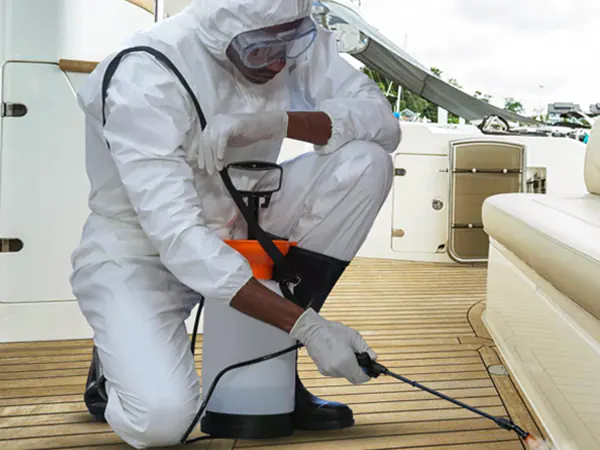
Vessel Fumigation Engineered for Abu Dhabi Port Operations
Our vessel fumigation in Abu Dhabi is built around how the ports actually run, because at sea the clock is the cost. For bulk carriers discharging grain and agricultural commodities at Khalifa Port, we carry out phosphine fumigation of the cargo holds in strict accordance with IMO guidelines, ADAFSA phytosanitary requirements, and the IMO Recommendations on the Safe Use of Pesticides in Ships. The technical work is only half of it. The other half is coordination. We work directly with port operations, vessel agents, and ADAFSA inspectors so the fumigation slots into the vessel's schedule rather than extending it, keeping berth time down while the cargo is brought into full compliance. For full details, see our complete vessel fumigation process.
ADAFSA & IMO Requirements for Vessel Fumigation in Abu Dhabi
Vessel fumigation in Abu Dhabi sits under three layers of regulation at once: ADAFSA at the local level, IMO guidelines internationally, and the phytosanitary standards of the cargo's destination. For shipowners, agents, and port operators, knowing how these fit together is not optional. A gap in any one of them can hold a vessel at berth. Here is what each requires.
ADAFSA Fumigation Licence
Only companies holding a valid ADAFSA fumigation licence may carry out vessel fumigation in Abu Dhabi's ports and anchorages, and the operators on board must hold individual ADAFSA fumigation operator certification, not just work under a company licence. Fumigation is among the most tightly controlled pest work there is, for good reason, and an unlicensed operator is both a safety risk and a compliance gap. Debug holds full ADAFSA licensing for maritime fumigation across the emirate.
IMO Fumigation Guidelines
All vessel fumigation has to comply with IMO MSC.1/Circ.1264, the Recommendations on the Safe Use of Pesticides in Ships, along with the IMDG Code provisions covering fumigated cargo transport units. These are safety rules first, written because fumigant gas in an enclosed vessel is lethal if mishandled. Debug follows the IMO-prescribed procedures throughout, covering gas application, concentration monitoring, crew safety, warning signage, and ventilation.
Phytosanitary Certification
Grain and agricultural shipments need phytosanitary fumigation certificates that the destination country's authorities will actually recognize. A certificate that does not hold up at the receiving port is worse than none, because the problem only surfaces after the cargo has sailed. Debug issues fumigation certificates detailing fumigant type, dosage, exposure period, and gas concentration readings, in the form accepted by quarantine authorities across all the major trading partner countries.
Ship Sanitation Certificate Compliance
A vessel that needs Ship Sanitation Certificate (SSC) renewal, or a Ship Sanitation Control Certificate (SSCC) issued, has to demonstrate effective pest management to get it. This is the document that follows the ship from port to port, so a lapse does not stay local. Debug provides the full vessel fumigation and pest treatment programmes that satisfy WHO International Health Regulations and UAE port health authority requirements, with the records to back the certificate.



What to Expect When You Book
Here is how the process runs, from the first call from a vessel agent through to gas-free certification.
Vessel Assessment & Planning
Send us the vessel particulars: name, IMO number, cargo type, tonnage, the berth or anchorage location, and the fumigation scope you need. Our maritime fumigation coordinator works through the details, confirms which regulatory requirements apply to that vessel and that cargo, and prepares a fumigation plan. That plan covers fumigant selection, dosage calculations, the exposure period, and the safety arrangements, all settled before anyone boards.
Pre-Fumigation Preparation
Our licensed fumigation team boards at berth or anchorage and runs a thorough pre-fumigation survey. Depending on the scope, we seal the cargo holds, the accommodation spaces, or the whole vessel. Gas detection equipment is calibrated on site, warning signage goes up in line with IMO requirements, and the master and crew get a full safety briefing covering emergency procedures and which areas are off limits. This stage is where the work is made safe, so it is not rushed.
Fumigation & Gas Monitoring
Fumigant is applied to the approved plan, not improvised on the day. For in-hold work, phosphine tablets or sachets are distributed evenly across the cargo surface so the gas reaches the whole hold. Concentration is monitored at the prescribed intervals with calibrated detectors, and every reading is logged for the fumigation certificate. Where the treatment runs in transit, we install the monitoring equipment before departure and brief the designated crew member on the ongoing gas checks they will carry out at sea.
Ventilation, Degassing & Certification
Once the exposure period is complete, we carry out controlled ventilation and degassing. This is the stage that makes the vessel safe to re-enter, so it is verified, not assumed. Gas-free readings are taken at multiple points across the treated spaces and confirmed below the safe re-entry threshold before clearance is given. You receive a detailed fumigation certificate, the gas concentration log, and a degassing clearance, all in the form accepted by ADAFSA, destination-port quarantine authorities, and vessel insurers. For operators running a fleet, our annual maintenance contracts provide scheduled vessel fumigation at preferential rates.
Frequently Asked Questions
Everything you need to know about vessel and ship fumigation in Abu Dhabi.
Bulk carriers, container vessels, offshore supply vessels, tankers, passenger vessels, dhows, and support craft operating in Abu Dhabi waters. The treatment differs by vessel and cargo, which is why the planning stage starts with the vessel particulars rather than a standard package.
Yes. In-transit fumigation lets the exposure period run while the vessel is under way rather than holding it at berth, which saves time on suitable voyages. It is carried out to IMO guidelines, with monitoring equipment installed before departure and a designated crew member briefed on the gas checks at sea.
It depends on the cargo type, the fumigant, and the exposure period the treatment requires. Most operations run from several hours to a few days. We confirm the expected timeline at the planning stage so it can be worked into the vessel's schedule.
Phosphine is the standard for grain and agricultural cargoes. The final selection depends on the vessel, the cargo characteristics, and the regulations that apply to the voyage, and it is set out in the fumigation plan before work begins.
Yes. We issue full fumigation certificates recognized by quarantine authorities, port health authorities, vessel insurers, and international shipping stakeholders, detailing fumigant type, dosage, exposure period, gas concentration readings, and degassing confirmation.
What Abu Dhabi Maritime Clients Say
Real results from vessel operators and shipping agents across Abu Dhabi — sourced from verified Google Reviews.
Book Vessel Fumigation in Abu Dhabi Today
Debug delivers IMO-compliant vessel and ship fumigation across all Abu Dhabi ports and anchorages — from Khalifa Port container operations to Das Island offshore facilities. ADAFSA licensed, internationally certified, and available 24/7 for urgent maritime fumigation requirements.
Licensed by ADAFSA. IMO Compliant. Rated 4.8★ on Google.