
Ship & Vessel Pest Control in Sharjah
Sharjah is unusual among the emirates in having ports on both coasts, but its maritime pest work is shaped above all by what comes through Hamriyah. The Hamriyah Free Zone Port has grown into a major bulk cargo and industrial gateway on the Arabian Gulf coast, and bulk cargo brings a particular kind of pest problem. Timber arrives with wood-borers. Grain arrives with stored-product insects. Steel and building materials arrive with whatever hitchhiked into the load. Alongside it, Port Khalid in the city centre handles general cargo and the traditional dhow traffic that runs the old coastal routes, and the Sharjah Container Terminal feeds the Northern Emirates. All of it needs certified fumigation to satisfy Sharjah Municipality, the Sharjah Ports Authority, and international shipping standards. Debug provides Sharjah Municipality-approved vessel and ship fumigation across every Sharjah port facility and anchorage. Call +971 6 546 2378 or request a quote online.
Why Vessel Fumigation Is Critical in Sharjah Waters
Sharjah's ports are not one type of operation, they are several, and each carries its own pest risk. Hamriyah moves bulk commodities and industrial cargo. Port Khalid runs general cargo and the older dhow traffic. The container terminal handles boxed freight. A timber bulk carrier and a wooden coastal show are completely different pest problems, and treating them the same way fails both. That range is the reason vessel fumigation in Sharjah cannot be a single standard procedure. Vessels calling here often need work beyond the hold as well, because the cargo moves straight into Hamriyah's warehousing and distribution network, so general fumigation for stored cargo and industrial pest management for the port-side storage and processing facilities frequently go together with the vessel treatment.
Hamriyah Free Zone Bulk Cargo Pests
Hamriyah Free Zone Port moves a heavy volume of bulk commodities, steel, timber, building materials, grain, and industrial raw materials, arriving from South Asia, East Africa, and the Far East. The pest risk splits by cargo type. Timber is the one people underestimate: shipments carry wood-boring insects and termite species that, if they reach the free zone untreated, do not just spoil a load, they can establish in the structures around them. Grain and food commodity cargoes carry the usual stored-product pests, Khapra beetle, rice weevil, and flour beetle among them. The danger point is discharge. Once infested cargo crosses from the vessel into the Hamriyah warehousing and distribution network, it contaminates whatever is stored alongside it and travels on with the next shipment. Certified fumigation at the berth, before discharge, is what keeps the problem on the ship.
- Timber imports from South Asia carry wood-boring insects that require treatment
- Grain and food commodity cargoes harbour stored-product beetles and moths
- Khapra beetle interceptions trigger mandatory fumigation before discharge
- Infested cargo entering Hamriyah warehouses contaminates adjacent stored goods
- Building material imports give hitchhiker pest species somewhere to shelter
- Pre-discharge fumigation at berth keeps pests out of the free zone facilities
Rodent Infestations on Coastal Traders
Sharjah's ports work a large fleet of coastal traders, feeder ships, and traditional dhows running regular routes to the Indian subcontinent, Iran, and East Africa. These are often older vessels with looser maintenance regimes than the big container lines, and that combination breeds established rodent populations rather than occasional stowaways. Norway rats and roof rats travel with the cargo from port to port, and the danger grows the longer a vessel sits alongside. A ship berthed for an extended period at Port Khalid or Hamriyah gives its rodents a bridge straight into port-side food sources and warehousing. This is why treating the vessel alone is not enough. The rodents move both ways across the gangway, so the vessel and the berth-side facilities have to be tackled together.
- Coastal trading vessels operating from Sharjah show elevated rodent infestation rates
- Traditional dhow construction offers multiple rodent harbourage points
- Rodents aboard berthed vessels migrate into port-side warehouses and facilities
- Extended alongside periods at Port Khalid let rodent populations grow
- Ship Sanitation Certificate inspections target rodent evidence in accommodation areas
- Combined vessel and berth-side treatment is needed for effective rodent elimination
Insect Infestations in Vessel Living Spaces
Cockroaches, bed bugs, and fly breeding in the crew's living spaces are constant for ships calling at Sharjah. The galley and engine room give German cockroaches everything they need, warmth, humidity, food preparation waste, and condensation, and a colony in those conditions does not stay small. Bed bugs arrive differently. They come aboard with people. A crew change at the Sharjah Container Terminal or Hamriyah can introduce them through personal luggage and effects, and from there they spread cabin to cabin and, when crew move ashore, between the ship and shoreside accommodation. On supply vessels carrying food, a pest-free galley is not optional, it is a certification requirement, which is why accommodation fumigation is often the part of the job that matters most.
- German cockroach colonies in galley areas are the primary vessel pest complaint at Sharjah
- Crew change operations introduce bed bugs through personal luggage and effects
- Engine room warmth and condensation give year-round cockroach breeding conditions
- Fly breeding in galley waste and deck drainage is common in the warmer months
- Food safety standards aboard supply vessels require pest-free galley certification
- Accommodation fumigation clears established insect populations in crew areas
Phytosanitary Non-Compliance Risks
A vessel trading through Sharjah answers to several rulebooks at once: Sharjah Municipality pest control regulations, Sharjah Ports Authority requirements, the IMO fumigation guidelines under MSC.1/Circ.1264, ISPM 15 for timber dunnage and packaging, and the phytosanitary standards of wherever the cargo is going. The exposure runs in both directions. Cargo discharged at Hamriyah without proper fumigation certification can be rejected by municipal inspectors on the way in. Outbound cargo without valid fumigation documentation gets held or rejected at the destination port on the way out. Either way the cost lands on the vessel. Having one provider handle every standard removes the gaps that open up when the compliance is split between parties.
- Sharjah Municipality and the Sharjah Ports Authority both enforce fumigation requirements
- IMO MSC.1/Circ.1264 governs safe pesticide use aboard vessels
- ISPM 15 compliance is mandatory for all timber dunnage and packaging materials
- Non-compliant cargo at Hamriyah risks rejection by municipal inspectors
- Outbound cargo without fumigation certificates faces destination-port holds
- Single-provider compliance across all standards streamlines port clearance
Vessel Fumigation Engineered for Sharjah Port Operations
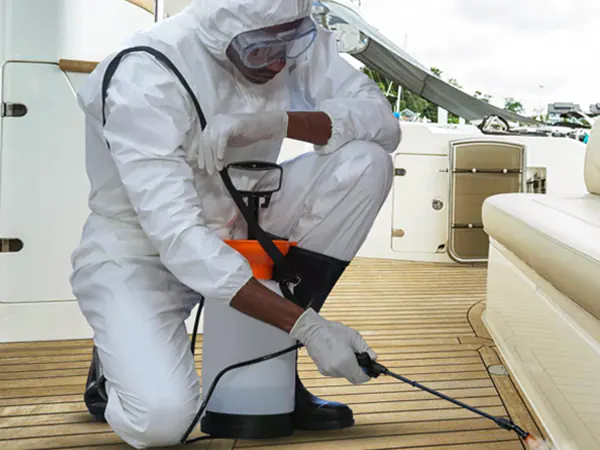
Our vessel fumigation in Sharjah is set up around the fact that each port here works differently. At Hamriyah Free Zone Port, the emirate's main bulk cargo and industrial shipping hub, we put teams on the job who know the bulk commodities, timber, and construction materials that make up most of Hamriyah's trade, because timber and grain are not fumigated the same way. Phosphine fumigation of the cargo holds follows dosage protocols worked out for the specific cargo type, the hold volume, and the high ambient temperatures normal to Arabian Gulf operations, since the same dose acts differently in that heat. Throughout, we coordinate directly with Hamriyah Free Zone port operations and the Sharjah Ports Authority so the treatment fits the berth schedule rather than stretching it.
Sharjah Municipality & IMO Requirements for Vessel Fumigation
Vessel fumigation in Sharjah sits under four sets of rules at once: Sharjah Municipality, the Sharjah Ports Authority, the IMO guidelines, and the phytosanitary standards of the cargo's destination. For shipowners, agents, and port operators, the Ports Authority layer is the one that bites the fastest, because it can stop discharge at the berth. Here is what each one involves.
Sharjah Municipality Fumigation Licence
Only companies holding a valid Sharjah Municipality pest control licence with a fumigation endorsement may carry out vessel fumigation in Sharjah's ports and anchorages, and the endorsement is specific, the general pest control licence does not cover it. Technicians must also carry their own Sharjah Municipality certification cards. Fumigation is among the most tightly regulated work in the trade, and an unlicensed operator leaves the compliance gap with you. Debug holds full Sharjah Municipality licensing for maritime fumigation across the emirate.
IMO & IMDG Code Compliance
All vessel fumigation has to comply with IMO MSC.1/Circ.1264, the Recommendations on the Safe Use of Pesticides in Ships, and with the IMDG Code provisions for fumigated cargo transport units. These are safety rules at heart, written because fumigant gas in a sealed vessel will kill if it is mishandled. Debug follows the IMO-prescribed procedures throughout, covering gas application, concentration monitoring, crew safety briefings, warning signage, and controlled ventilation.
Sharjah Ports Authority Requirements
The Sharjah Ports Authority requires vessels carrying regulated cargo to present valid fumigation documentation before discharge is allowed at Port Khalid, Hamriyah Free Zone Port, or the Sharjah Container Terminal. This is the requirement that holds a ship at the berth if it is not met, so it is the one to get right before arrival rather than after. Debug provides fumigation services and documentation that satisfy the Sharjah Ports Authority requirements for cargo clearance in full.
Phytosanitary & Ship Sanitation Certification
Grain and commodity shipments need phytosanitary fumigation certificates that the destination country's authorities will recognize, and a certificate that fails at the receiving port is worse than none because the cargo has already sailed. Separately, any vessel due a Ship Sanitation Certificate renewal has to demonstrate effective pest management to obtain it. Debug issues full fumigation certificates and runs complete vessel treatment programmes that satisfy both the phytosanitary requirements and the WHO International Health Regulations.


What to Expect When You Book
Here is how the process runs, from the first call from a vessel agent through to gas-free certification.
Vessel Assessment & Planning
Send us the vessel particulars: name, IMO number, cargo type, tonnage, the berth or anchorage location, and the fumigation scope you need. Our maritime fumigation coordinator works through the details, confirms which Sharjah Municipality and Sharjah Ports Authority requirements apply to that cargo, and prepares the fumigation plan, covering fumigant selection, dosage calculations, the exposure period, and the safety arrangements. With Sharjah specifically, this is also where we make sure the Ports Authority documentation will be ready before the vessel is due to discharge.
Pre-Fumigation Preparation
Our licensed fumigation team boards at berth or anchorage and runs a thorough pre-fumigation survey. Depending on the scope, we seal the cargo holds, the accommodation spaces, or the whole vessel. Gas detection equipment is calibrated on site, warning signage goes up in line with IMO requirements, and the master and crew get a full safety briefing covering emergency procedures, restricted areas, and the watch-keeping requirements during treatment. This is the stage that makes the operation safe, so it is not hurried.
Fumigation & Gas Monitoring
Fumigant is applied to the approved plan rather than improvised on the day. For in-hold work at Hamriyah or Port Khalid, phosphine tablets or sachets are distributed evenly across the cargo surface and the holds are sealed so the gas reaches the whole space. Concentration is monitored at the prescribed intervals with calibrated detectors, and every reading is logged for the fumigation certificate. Where the treatment runs in transit, we install the monitoring equipment before departure and brief the designated crew member on the gas checks they will carry out at sea.
Ventilation, Degassing & Certification
Once the exposure period is complete, we carry out controlled ventilation and degassing. This is the step that makes the vessel safe to re-enter, so it is verified, not assumed. Gas-free readings are taken at multiple points across the treated spaces and confirmed below the safe re-entry threshold before clearance is given. You receive a detailed fumigation certificate, the gas concentration log, and a degassing clearance, all in the form accepted by Sharjah Municipality, the Sharjah Ports Authority, destination-port quarantine authorities, and vessel insurers. For operators running a fleet, our annual maintenance contracts provide scheduled vessel fumigation at preferential rates.
Frequently Asked Questions
Everything you need to know about vessel and ship fumigation in Sharjah.
Bulk carriers, container ships, general cargo vessels, coastal traders, traditional dhows, offshore vessels, and support boats operating across Sharjah's ports. Given how much of Sharjah's traffic is bulk cargo and older coastal craft, a lot of our work here is timber and grain holds and the higher pest risk that comes with wooden dhows.
Yes. Hamriyah is one of the ports we work most. We provide vessel fumigation throughout Hamriyah Free Zone Port, Port Khalid, the Sharjah Container Terminal, and the approved anchorages, with documentation prepared for Sharjah Ports Authority clearance.
It depends on the cargo type, the vessel size, the fumigant, and the exposure period the treatment needs. Most operations run from several hours to a few days. With bulk timber and grain cargoes the exposure period is the main factor, and we plan it to fit the berth window.
Phosphine is the standard for grain and agricultural cargoes and is also widely used for timber and bulk commodities. The final selection depends on the cargo, the vessel, and the regulations for the voyage, and it is set out in the fumigation plan before work starts.
Yes. We issue full fumigation documentation accepted by Sharjah Municipality, the Sharjah Ports Authority, and international quarantine authorities, detailing fumigant type, dosage, exposure period, gas concentration readings, and degassing clearance so it holds up both at Sharjah on discharge and at the destination port.
What Sharjah Maritime Clients Say
Real results from vessel operators and shipping agents across Sharjah — sourced from verified Google Reviews.
Book Vessel Fumigation in Sharjah Today
Debug delivers IMO-compliant vessel and ship fumigation across all Sharjah ports and anchorages — from Hamriyah Free Zone's industrial shipping hub to Port Khalid's city-centre berths. Sharjah Municipality approved, internationally certified, and available 24/7 for urgent maritime fumigation requirements.
Sharjah Municipality Approved. IMO Compliant. Rated 4.8★ on Google.